
Jun 8, 2026
Starfish Barometer 2026 warns that accelerating ocean change is outpacing global response
WORLD OCEAN DAY 2026
The Starfish Barometer 2026, an international scientific assessment of the relationship between the Ocean and Humanity, is published today in State of the Planet. Drawing on the latest peer-reviewed science and international assessments, the report highlights accelerating ocean change, rising societal and economic impacts, and a widening gap between human pressures and protection efforts. First launched at the third United Nations Ocean Conference in 2025, the 2026 edition has grown into a global, multidisciplinary scientific effort, bringing together 29 experts from 14 countries across oceanography, climate science, ecology, economics and social sciences.
Its conclusion is clear: ocean degradation is continuing, with signs of acceleration across several major indicators, while political, financial and conservation responses remain too limited in scale and speed. Despite this, important governance milestones signal growing international action on ocean and biodiversity protection.
What’s new in 2026
Section titled “What’s new in 2026”While revisiting key issues identified in 2025, the 2026 edition highlights several major developments in the Ocean–Humanity relationship:
- Acceleration of ocean change is becoming increasingly observable in global datasets, particularly for sea-level rise and ocean warming;
- Societal impacts are becoming more visible, with rising economic losses, humanitarian risks and growing pressure on coastal economies;
- Major governance milestones have been achieved, including the entry into force of the High Seas Treaty (BBNJ) and the WTO agreement limiting harmful fisheries subsidies;
- A new concern is emerging: weakening ocean observing systems are threatening the world’s ability to monitor the state and evolution of the Ocean.
Dr. William W. L. Cheung contributed to the Starfish Barometer 2026 as the lead of the Human Pressures branch. His contribution drew on expertise in climate change impacts on marine ecosystems and fisheries, ocean sustainability, and the food–climate–biodiversity nexus.
As a country bordered by three oceans, Canada depends on healthy marine ecosystems for food security, coastal livelihoods, Indigenous cultures, biodiversity, and climate regulation. “For Canada, this reinforces the importance of reducing pressures at their source while advancing our commitment to protect 30% of marine and coastal areas by 2030 in partnership with Indigenous Peoples and coastal communities,” said Cheung.
The Starfish Barometer shows that human pressures on the ocean remain structurally high. These pressures interact with accelerating ocean warming, sea-level rise, biodiversity loss, and growing societal harms, underscoring the need for stronger ocean monitoring, science-based management, and coordinated action. “Human pressures on the ocean are not easing at the pace needed,” noted Cheung.
The Barometer also points to pathways for action. Strengthening ocean observing systems is essential so that Canada and the global community can track accelerating ocean change and respond before impacts become irreversible. Reducing pressures at their source, including emissions, pollution, unsustainable fishing, and poorly governed emerging activities, must go hand in hand with more effective protection, including marine protected areas that are not only designated but fully implemented, monitored, and enforced. Realizing these actions requires investment, governance, and policies that align ocean use with long-term ecosystem health and social equity.
An integrated view of the Ocean–Humanity relationship
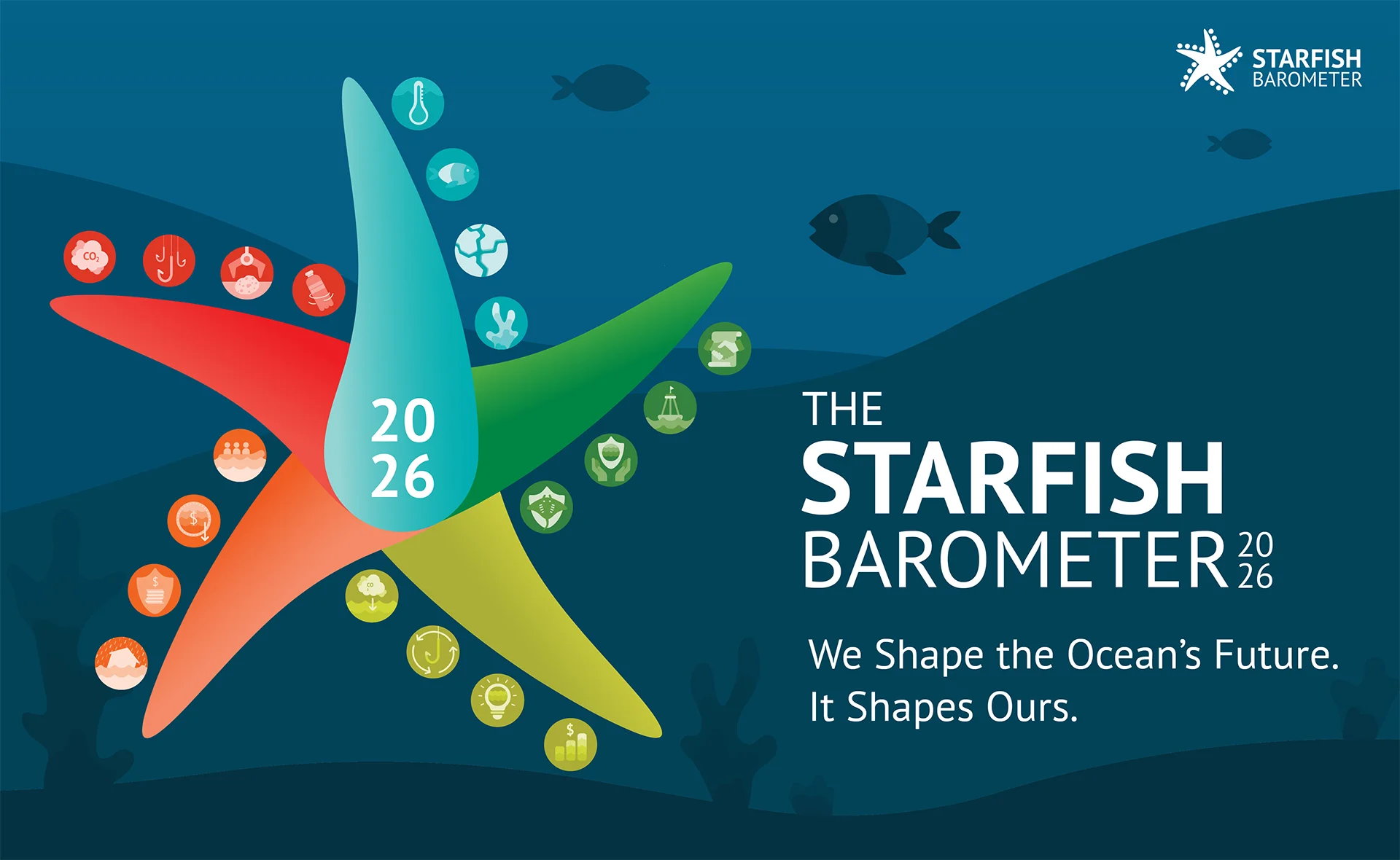
Section titled “An integrated view of the Ocean–Humanity relationship”The Starfish Barometer is structured around five interconnected dimensions: Ocean state, human pressures, societal harms, protection efforts and opportunities for humanity. The Scientific Committee is chaired by Marina Lévy (CNRS) and co-chaired Karina von Schuckmann (Mercator Ocean International). Operational implementation is led by Mercator Ocean International.
“We often observe ocean signals separately – from warming to pollution and biodiversity loss – but rarely as a connected system. The Starfish Barometer brings these dimensions together, helping us understand not just what is happening, but how it all links together,” said Dr. Marina Lévy, Chair of the Scientific Committee.
“In a rapidly changing ocean, the imperative is to translate knowledge into action. The Starfish Barometer provides that bridge between science, policy and society,” added Karina von Schuckmann, Co-Chair of the Scientific Committee.
“The Starfish Barometer is designed as a decision-support tool. By connecting ocean observations, science and societal impacts, it helps identify blind spots, guide research and investment priorities, and support more coherent action at system level,” said Pierre Bahurel, Director General of Mercator Ocean International.
About the Starfish Barometer
Section titled “About the Starfish Barometer”The Starfish Barometer is an annual, science-based initiative providing an accessible synthesis of the relationship between the Ocean and Humanity. It is structured around five interconnected dimensions: Ocean state, human pressures, societal harms, protection efforts, and opportunities for humanity. It consolidates and translates authoritative scientific knowledge from peer-reviewed literature and major international assessments.
First launched at the United Nations Ocean Conference in 2025, the Starfish Barometer is published annually on World Ocean Day. Its findings are also included in the annual Copernicus Marine Service Ocean State Report, linking it to the broader international scientific community monitoring the Ocean.