
Theoretical Approach
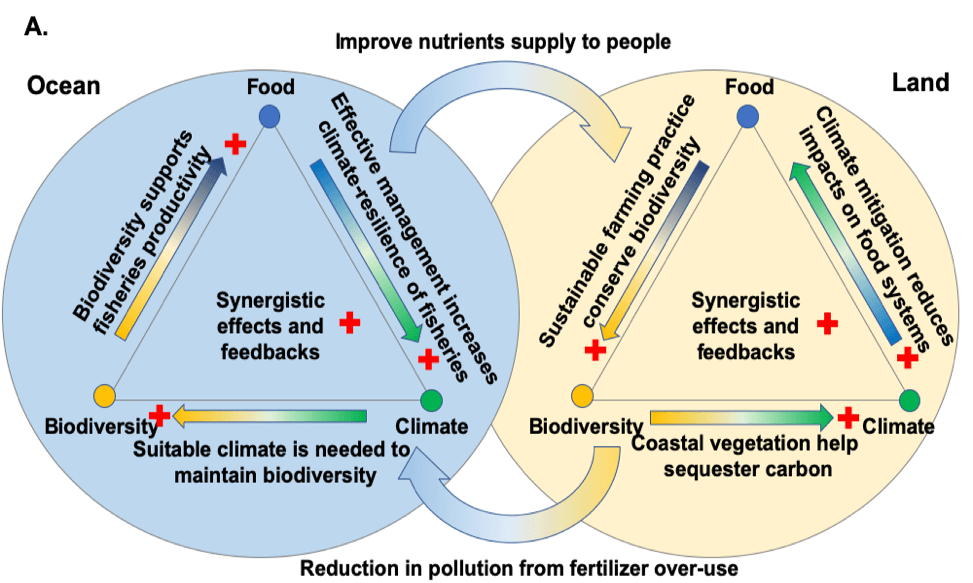
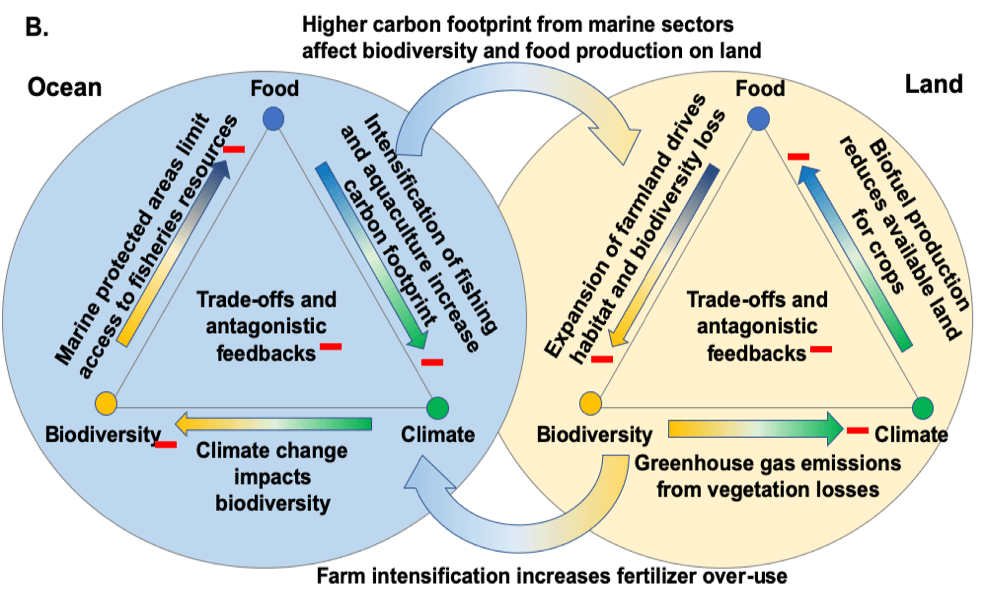
The proposed Partnership is transdisciplinary and uses a “multicentric” nexus approach to identify transition and transformation pathways toward “desirable” futures where FCB challenges can be addressed simultaneously (Figure 1). This approach explicitly recognizes the inherent interconnectedness and interdependence of human systems (e.g., economic, social) and natural systems (e.g., hydrologic, atmospheric, biological). By applying a systems perspective to these coupled human-natural systems, the Partnership resolves complex resource and development issues at their intersection. This enables us to uncover co-benefits, examine trade-offs, anticipate unexpected consequences, and achieve sustainable development outcomes (Figure 1).
Figure. 1. Conceptual diagram illustrating the food-biodiversity-climate nexus on ocean and land:
Solving complex, interconnected FCB challenges requires bridging diverse sources of experience and knowledge. A transdisciplinary approach is essential to find these solutions, bringing together researchers, knowledge-holders, stakeholders, and rights-holders to co-develop knowledge and policy options. Specifically, this Partnership facilitates collaboration between scholars—spanning anthropology, economics, resource management, public policy, climate sciences, ecology, fisheries, and agriculture and nutritional science—and practitioners with established links to policymakers.
To support FCB actions, this collaborative approach involves:
- Understanding the linkages between human and natural systems;
- Exploring how scenario drivers and FCB policies affect these systems; and
- Incorporating this information directly into policy discussions.
As policymakers face increasingly complex decisions, they require new kinds of information to navigate this environment. This has led to widespread calls for more integrated, contextualized, and goal-seeking evaluations of different policies, designed specifically for multi-scale decisions and action. Consequently, the demand for knowledge must shift: moving beyond merely assessing current trends (“what is happening”) toward identifying the actual transformations required to achieve more sustainable futures (“how to change”).