
China Case Study
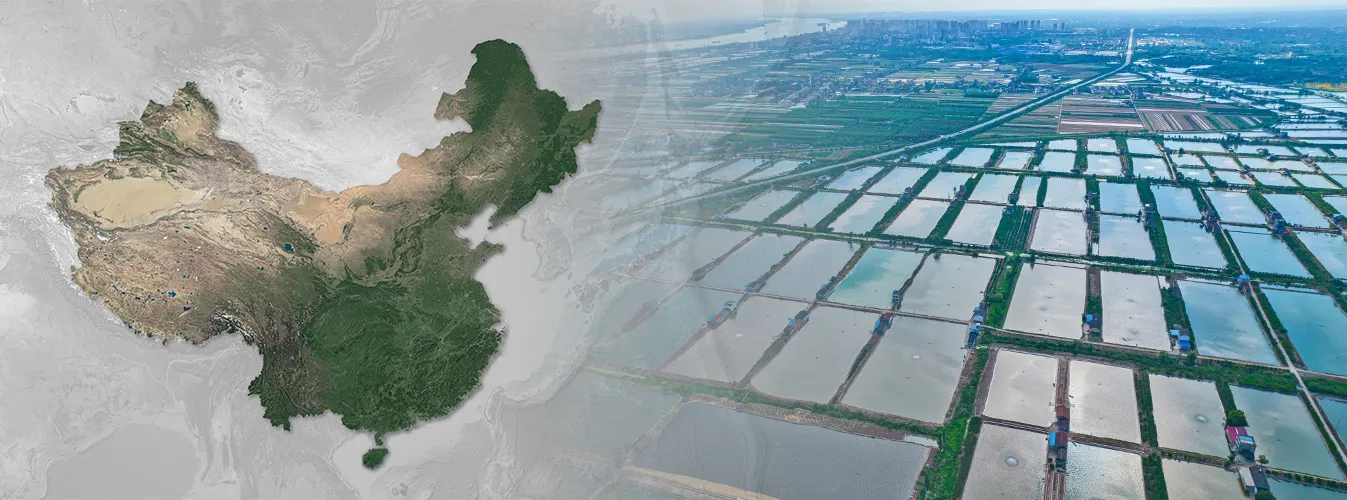
In China, the Partnership examines the nexus of aquaculture expansion to increase seafood provision and carbon sequestration to conserve coastal biodiversity.
Overview
Section titled “Overview”China's coastline connects with the North Pacific Ocean and faces the coastline of North America. The coastline is approximately 18,000 km, spanning tropical, subtropical and temperate zones, with a shallow water area within the 15 m isobath covering around 140,000 km². China has a long history of mariculture and is the largest mariculture producer by weight and value, contributing greatly to food production and livelihoods locally and globally. Chinese marine ecosystems are under pressure (e.g. hypoxia, eutrophication) from intense human use; risks include pollution, species decline and climate change (including ocean acidification). Despite this, sustainable mariculture has the potential to become an important component of pathways towards desirable ocean futures. The China case study examines the challenges and opportunities of sustainable mariculture through field data and simulation modelling.
Developing aquaculture for food, climate mitigation and biodiversity
Section titled “Developing aquaculture for food, climate mitigation and biodiversity”Background
Section titled “Background”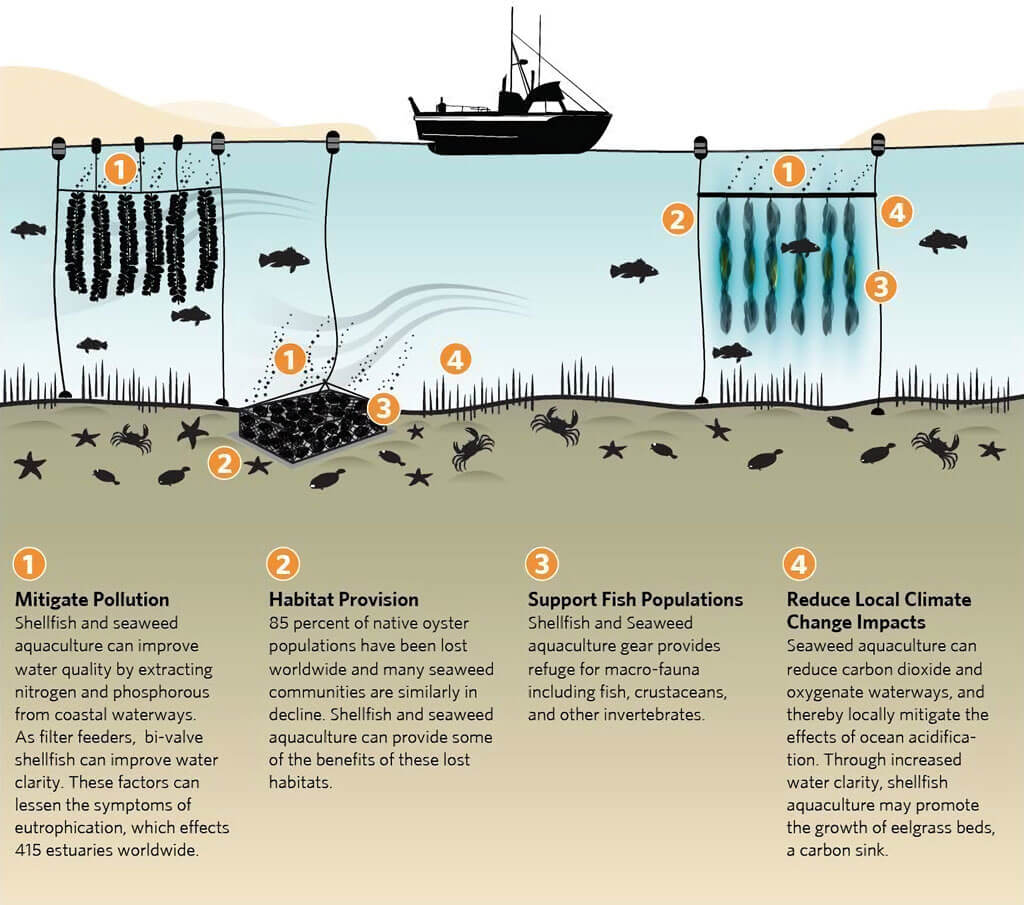
| Service category | Service | Potential species providing service | | --- | --- | --- | | Provisioning | Augment wild fisheries catches | Bivalves, Fish, Algae | | Regulating | Carbon sequestration | Bivalves, Algae | | | Acidification regulation | Algae | | | Coastal protection | Bivalves, Fish, Algae | | | Nutrient removal | Bivalves, Algae | | | Improve water clarity | Bivalves, Algae | | Habitat and supporting | Provision of artificial habitat | Bivalves, Fish, Algae | | Cultural | Livelihoods | Bivalves, Fish, Algae, Crustacea | | | Tourism | Bivalves, Fish, Algae, Crustacea |
China's developing mariculture has made significant contributions to ensuring food security since 1949. In 2012, China's mariculture output accounted for more than 70% of the world's total output. The "Blue Granary" strategy aims to improve the output and quality of marine aquatic products while maintaining the protection of the marine ecological environment. Shandong (Subei, north Jiangsu) and Fujian province are among the largest seaweed and bivalve producers.
Purpose of the study
Section titled “Purpose of the study”Answering the question: Whether seaweed & shellfish cultivation could help Solving-FCB? If so, how?
- Target 1 - Expansion potential: Species distribution modelling and environment suitability maps (e.g. species distribution maps) to quantify the expansion potential of marine seaweed and bivalve cultivation.
- Target 2 - Carbon: Account for the maximum potential of carbon sequestration by seaweed and bivalve cultivation (including burial/culture and carbon reservation maps), building on species distribution work from Target 1.
- Target 3 - Habitat provision: Validate the habitat provision services of seaweed and bivalve cultivation (including infrastructure) via field work; focus on seaweed cultivation and biodiversity. An environmental DNA (eDNA) approach is used in North Jiangsu Province and Xiapu, Fujian Province.
- Target 4 - Climate change: Quantify the impact of climate change on seaweed cultivation production and ecosystem service potential. Seaweed can help oxygenate acidic waters and improve water clarity for shellfish aquaculture; algae and seagrasses may benefit from higher CO₂ for photosynthesis, promoting seaweed beds that can act as a carbon sink if production is stored or buried over long timescales.
Sustainable mariculture has the potential to support food, climate and biodiversity goals. The case study aims to understand the capacity and limits for developing seaweed mariculture through field data and simulation modelling.


Updates
Section titled “Updates”References and links
Section titled “References and links”- Blue Granary and mariculture (ScienceDirect)
- Xiao et al. (2017). Nutrient removal from Chinese coastal waters by large-scale seaweed aquaculture. Scientific Reports 7, 46613.
- FAO (2022). The State of World Fisheries and Aquaculture 2022: Towards Blue Transformation.
- Wang et al. (2016). Eutrophication-Driven Hypoxia in the East China Sea off the Changjiang Estuary. Environmental Science & Technology 50(5), 2255–2263.
- Development ideas and implementation approaches of blue granary (CAB Direct)
- Habitat provision (MDPI)
- Ocean acidification (NOAA)
Outputs
- System-specific aquaculture annual growth rates can mitigate the trilemma of production, pollution and carbon dioxide emissions in China (2025-02-11)
- Comparative analysis of climate-induced changes in distribution of representative fish species in the Yellow Sea (2024-02-01)
- Detecting, attributing, and projecting global marine ecosystem and fisheries change: FishMIP 2.0 (2024-01-22)
- Spatiotemporal variation of China’s mariculture potential under climate change (2023-11-28)
- Global estimates of suitable areas for marine algae farming (2023-06-01)