
Jun 19, 2026
Why Climate Change Makes a High Seas Fishing Ban More Urgent Than Ever
The impacts of climate change are not just warming our atmosphere; they are actively reshaping the geography of our oceans. As water temperatures rise, marine species are moving in search of cooler habitats.
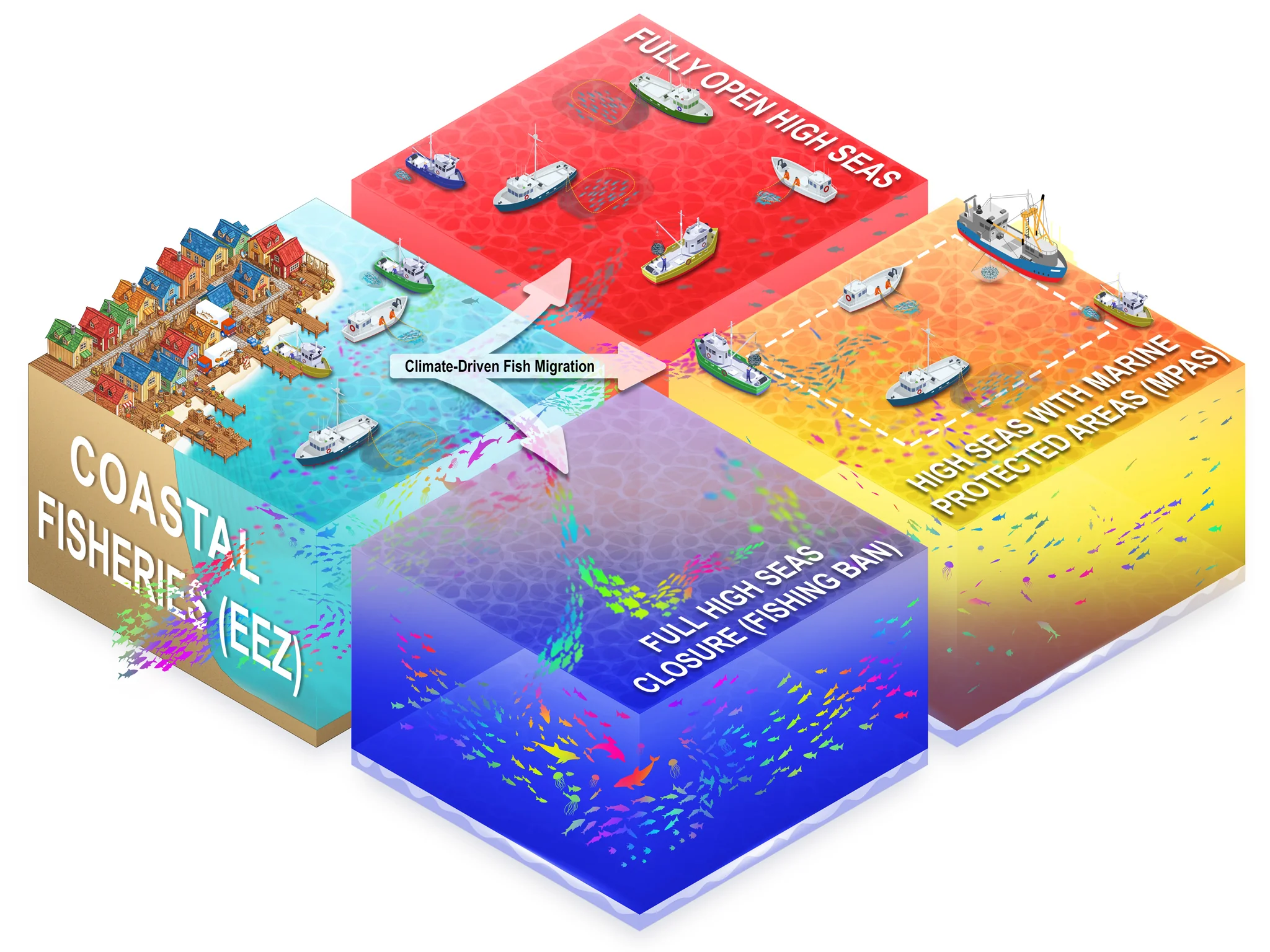
A new paper published in Frontiers of Biogeography by Solving-FCB PI William Cheung, Led by Co-PI Rashid Sumaila, Juliano Palacios-Abrantes, and Duncan Burnside, highlights a critical shift: even under a low-emission scenario, approximately 22% of straddling fish stocks are projected to move out of Exclusive Economic Zones (EEZs) and into the high seas - international waters beyond the jurisdiction of any single nation - by the year 2030.
This rapid redistribution of marine biomass introduces serious ecological, economic, and social challenges. However, they argue that it also strengthens the case for a policy long debated: a complete ban on high seas fishing.
1. Creating a Safe Harbour for Marine Life
Section titled “1. Creating a Safe Harbour for Marine Life”The high seas are among the least regulated and most difficult to monitor regions on the planet. Shifting fish stocks into these waters exposes them to heightened risks of overexploitation, illegal, unreported, and unregulated (IUU) fishing, and destructive practices.
Implementing a high seas fishing ban would effectively turn international waters into a “biodiversity refuge” or a global “fish bank.” Much like wildlife corridors on land, a protected high seas would allow migrating species a safe space to navigate, spawn, and recover, helping marine ecosystems build resilience against climate-induced stress.
2. Safeguarding Global Equity
Section titled “2. Safeguarding Global Equity”The shifting of fish populations has profound socioeconomic implications, particularly for developing coastal nations in the tropics. These regions, which are heavily reliant on fisheries for food security and local livelihoods, are projected to experience the greatest biomass losses to the high seas.
In the absence of a ban, wealthy nations with large, heavily subsidized distant-water fleets (DWFs) are the most equipped to chase these migrating stocks into international waters. This creates a deeply inequitable scenario where coastal communities lose access to resources that historically sustained them, while a handful of wealthy nations capture the benefits. Reframing a high seas ban as a form of climate adaptation policy would prevent powerful actors from capitalizing on the climate-driven misfortunes of vulnerable nations.
3. Preventing an “Emissions Spiral”
Section titled “3. Preventing an “Emissions Spiral””High seas fishing is an incredibly energy-intensive industry. Vessels must travel immense distances and spend prolonged periods at sea, consuming vast quantities of fuel. If climate change forces fish further offshore, fleets will likely respond by traveling further and staying out longer, triggering an “emissions spiral” that undermines global climate goals.
Furthermore, research indicates that catching large fish prevents them from naturally dying and sinking to the seafloor, a process that historically sequestered significant amounts of blue carbon. A ban on high seas fishing would restrict activities to closer coastal zones, lowering fuel use, reducing carbon footprints, and preserving the ocean’s natural carbon sinks.
The Path Forward
Section titled “The Path Forward”Transitioning to a climate-adaptive high seas ban is not without its hurdles. To remain equitable and effective, such a policy must be paired with robust fisheries management within national EEZs. It also requires the international community to develop creative benefit-sharing and compensatory mechanisms for coastal nations losing resources.
Ultimately, the science shows that climate change is erasing traditional boundaries in the ocean. By treating the high seas as a protected global commons, humanity has an opportunity to secure a shared insurance policy for biodiversity, food security, and climate stability.
- View the paper at Frontiers of Biogeography.
- View the paper on SolvingFCB.org.
- View all Solving-FCB Publications.